
How to optimise your workstation for SketchUp Pro 2026

SketchUp Pro is a powerful yet economical CAD tool for sophisticated 2D and 3D models in architecture, product design, advertising and graphic design. However, as projects grow in size, it becomes clear that it is not only the software that determines how smoothly you can work, but above all the hardware on which it runs. SketchUp Pro is designed for precision – and this precision requires a system environment that reliably supports it. Complex geometries, large amounts of data and detailed models can quickly become a test of patience if the computing power, graphics card or RAM are not optimally matched. The result is delays, stuttering or unnecessary waiting times that slow down the creative flow.
Our customised workstations ensure that SketchUp Pro can reach its full potential: smooth navigation, stable display even with very complex models and a noticeably more efficient workflow. You gain time, planning security and the freedom to concentrate fully on your designs instead of technical limitations.
We configure the optimal business workstation for you, tailored precisely to your individual SketchUp applications and project requirements. So that you can experience the difference for yourself, we offer you the opportunity to test the system in detail via remote access with a SketchUp Pro trial licence.
Contact us to arrange a free remote test. Below you will find our expertise for SketchUp Pro 2026:
The best SketchUp Pro workstation recommendations from Uli Ludwig
The best SketchUP processors for smooth business workflows – from small sketches to complex 3D projects
SketchUp Pro 2026 primarily benefits from high single-core performance, as most modelling functions only use one processor core. However, multi-core processors can also be advantageous for particularly computationally intensive tasks such as rendering (with V-Ray, Enscape, etc.). Choosing the right processor depends heavily on the scope of the project – whether it's simple designs, medium-sized architectural models or complex BIM models with numerous components.
Here are the optimal Intel processors for different project sizes:
Small SketchUp projects – interiors, furniture, simple architecture
Intel Core recommendation:
Intel Core i5-14600K
14 cores (6P+8E), up to 5.3 GHz. Excellent single-core performance at an attractive price.
Intel Core i7-14700K
20 cores (8P+12E), up to 5.6 GHz. More reserves for multitasking and occasional rendering.
Intel Xeon recommendation:
Intel Xeon W-2225
6 cores, 3.6 GHz (turbo up to 3.9 GHz). Solid performance for simple CAD tasks with ECC RAM support.
Intel Xeon W-2245
8 cores, up to 4.50 GHz. Ideal for small workstations with professional requirements.
Medium SketchUp projects – small buildings, interior design, technical constructions
Intel Core recommendation:
Intel Core i7-14700K
High clock frequencies and 20 cores offer very good performance for modelling and parallel work.
Intel Core i9-14900K
Up to 6.0 GHz Turbo Boost, ideal for more complex models with smooth navigation and fast calculations.
Intel Xeon recommendation:
Intel Xeon W-2265
12 cores, 3.70 GHz (turbo up to 4.5 GHz). Excellent for stable workstation operation and larger projects.
Intel Xeon W5-2445 (Sapphire Rapids)
12 cores, modern platform with DDR5 and PCIe 5.0 support. Future-proof and stable.
Complex SketchUp projects – urban planning, large BIM models, high-end visualisation
Intel Core recommendation:
Intel Core i9-14900K
Currently Intel's fastest consumer processor. Up to 6.2 GHz – ideal for extremely demanding modelling processes.
Intel Core i9-Ultra
High-end CPU for maximum performance, especially in combination with a professional GPU.
Intel Xeon recommendation:
Intel Xeon W9-3475X
36 cores, extremely high multicore performance. Perfect for hybrid workflows (modelling + parallel rendering).
Intel Xeon Scalable 8440+ (4th Gen)
For extremely large projects in network or server environments. Scalable performance, ECC RAM and remote CAD compatible.
Our conclusion
A high clock speed is crucial for SketchUp Pro 2026 – especially for interactive modelling. 14th generation Intel Core processors offer excellent performance for single-user systems. For professional environments where stability, ECC memory and long availability are paramount, Intel Xeon processors are the better choice.
Optimal RAM configurations for SketchUp Pro 2026
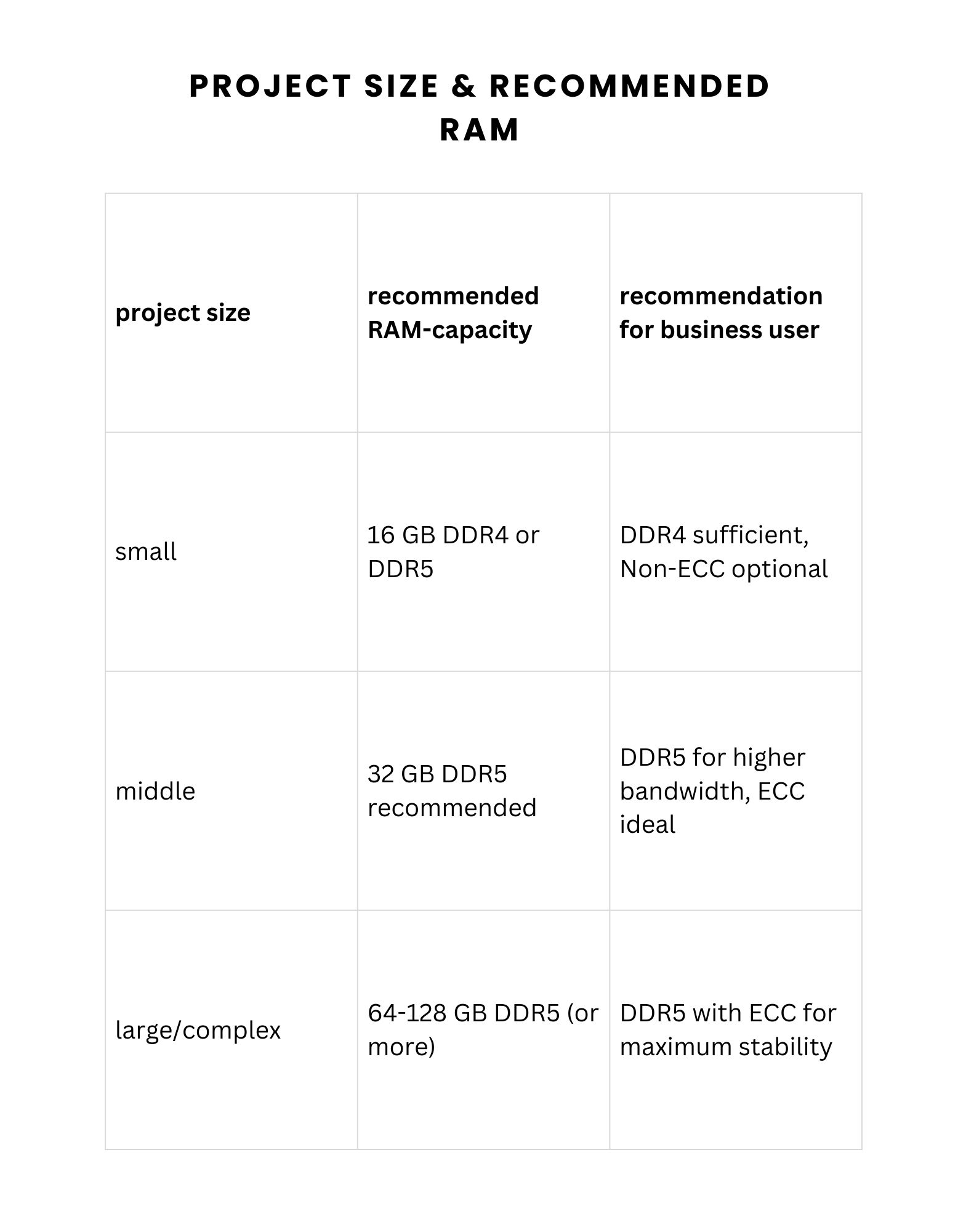
SketchUp Pro 2026 sets new standards in terms of performance, efficiency and stability – especially for memory-intensive modelling and rendering processes. To realise the full potential of the software, choosing the right RAM is crucial. This guide provides an overview of the optimal RAM configurations for different project sizes and highlights the differences between DDR4 and DDR5 as well as ECC and non-ECC RAM.
A guide for business customers: DDR4 vs. DDR5 | ECC vs. non-ECC
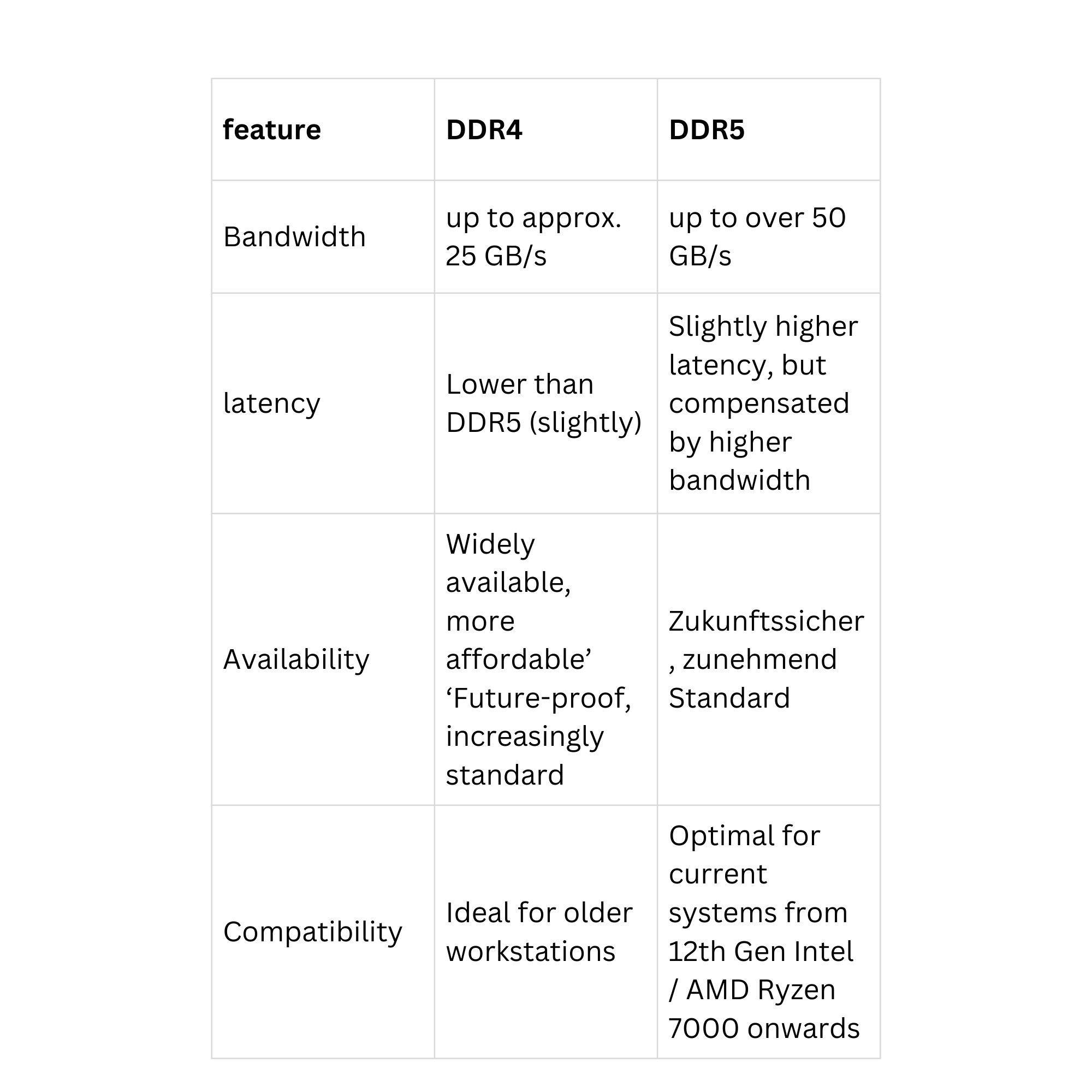
 DDR4 vs. DDR5 – Which is better for SketchUp Pro 2026?
Our conclusion:
DDR4 is often still sufficient for small to medium-sized projects, provided that the project complexity remains manageable. For larger models, real-time rendering or parallel workloads, DDR5 has a clear advantage due to its higher memory bandwidth and efficiency.
ECC vs. Non-ECC – Stability for professional workflows

Our conclusion:
ECC RAM is highly recommended for business customers who work with complex projects, collaborative workflows or long-term projects. It minimises crashes, data errors and system failures – particularly important for long rendering processes or CAD editing.
Recommended combinations for business users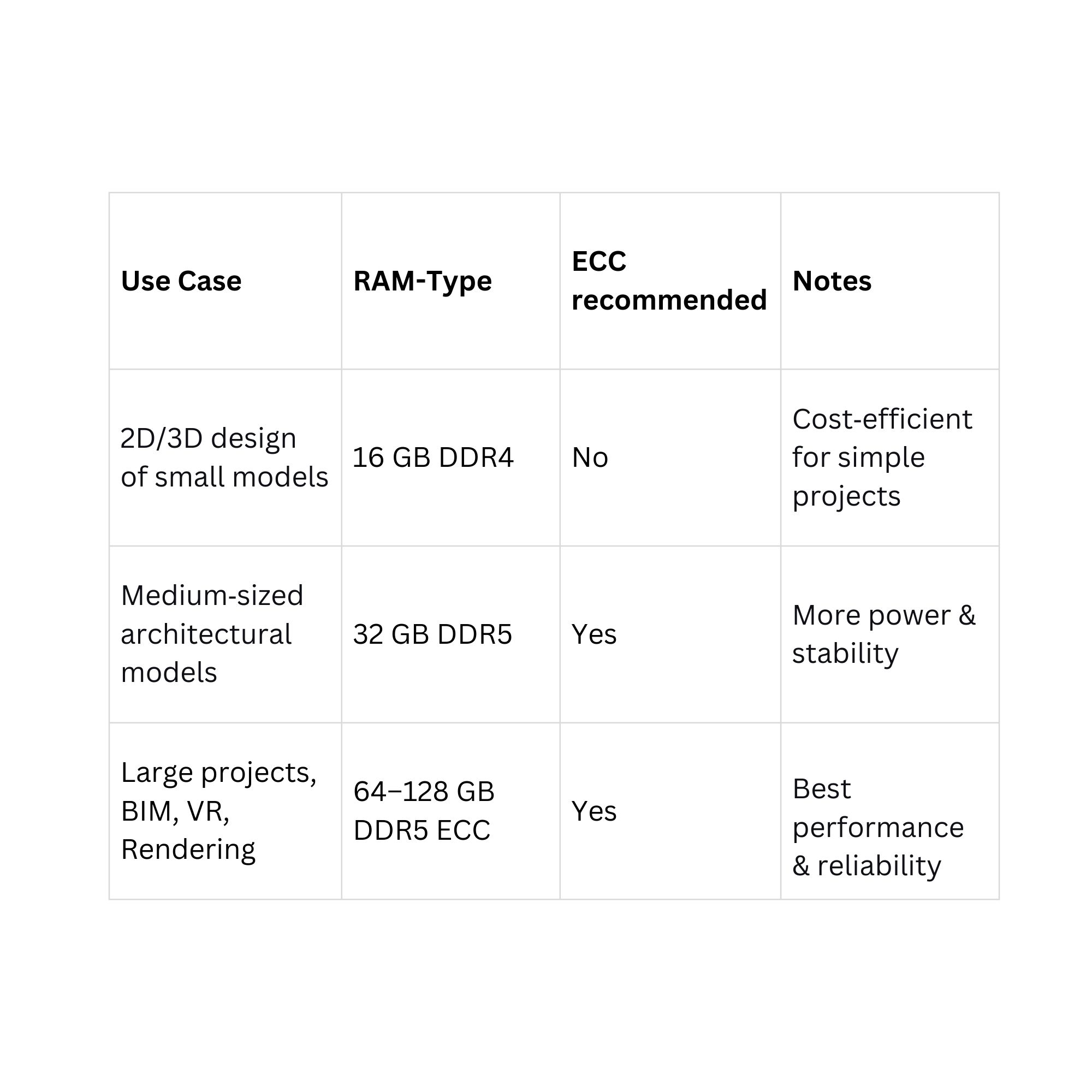 Our conclusion
For companies that use SketchUp Pro 2026 productively and professionally, RAM is a key performance factor. While DDR4 is still sufficient for simple projects, DDR5 offers significant advantages in terms of speed and efficiency for medium and large projects. ECC RAM is particularly recommended for complex workflows – it increases system stability and reduces the risk of data loss.
Uli's extra tip: Combine DDR5 with ECC in a current workstation system for the best future-proofing and performance for all SketchUp projects.
Recommendation for optimal graphics cards for SketchUp Pro 2026
Focus: NVIDIA RTX vs. GeForce – for small, medium and complex projects
Choosing the right graphics card is crucial for smooth and stable work with SketchUp Pro 2026, especially when working with large 3D models or using real-time rendering plugins such as V-Ray, Enscape or Twinmotion.
SketchUp project size: Small models / single rooms / interior design
Requirements:
Floor plans, small interiors, furnishing plans
Little geometry, moderate texture resolution
No or only occasional real-time rendering
Recommendation:
Nvidia GeForce RTX 5060 (8 GB GDDR7)
Very good price-performance ratio, sufficient for modelling and light rendering work.
Nvidia RTX A2000 (6 or 12 GB GDDR6, workstation card)
ISV-certified for professional CAD software, quiet & energy-efficient. Ideal for business environments.
SketchUp Project size: Medium-sized models / residential buildings / interior design with visualisation
Requirements:
Building models with multiple floors
Use of rendering plugins
Stable performance with multiple files open simultaneously
Recommendation:
Nvidia GeForce RTX 5070 (12 GB GDDR7X)
Very powerful, good ray tracing performance, excellent price-performance ratio for semi-professional workflows.
Nvidia RTX A4000 (16 GB GDDR6, ISV-certified)
Workstation card with high reliability and memory reserves for more complex scenes; ideal for architectural firms.
SketchUp Project size: Complex models / Large projects / Urban planning / BIM integration
Requirements:
High model complexity, numerous groups/components
Real-time rendering, VR integration, collaboration with Revit or Rhino
Maximum stability and performance
Recommendation:
Nvidia GeForce RTX 5090 (32 GB GDDR7X)
Extremely powerful, good for intensive rendering tasks and real-time previews, but no ISV certification.
NVIDIA RTX 5000 Ada generation (32 GB GDDR6, ISV-certified)
High-end solution for workstations, maximum stability, especially for demanding business customers with certification requirements.
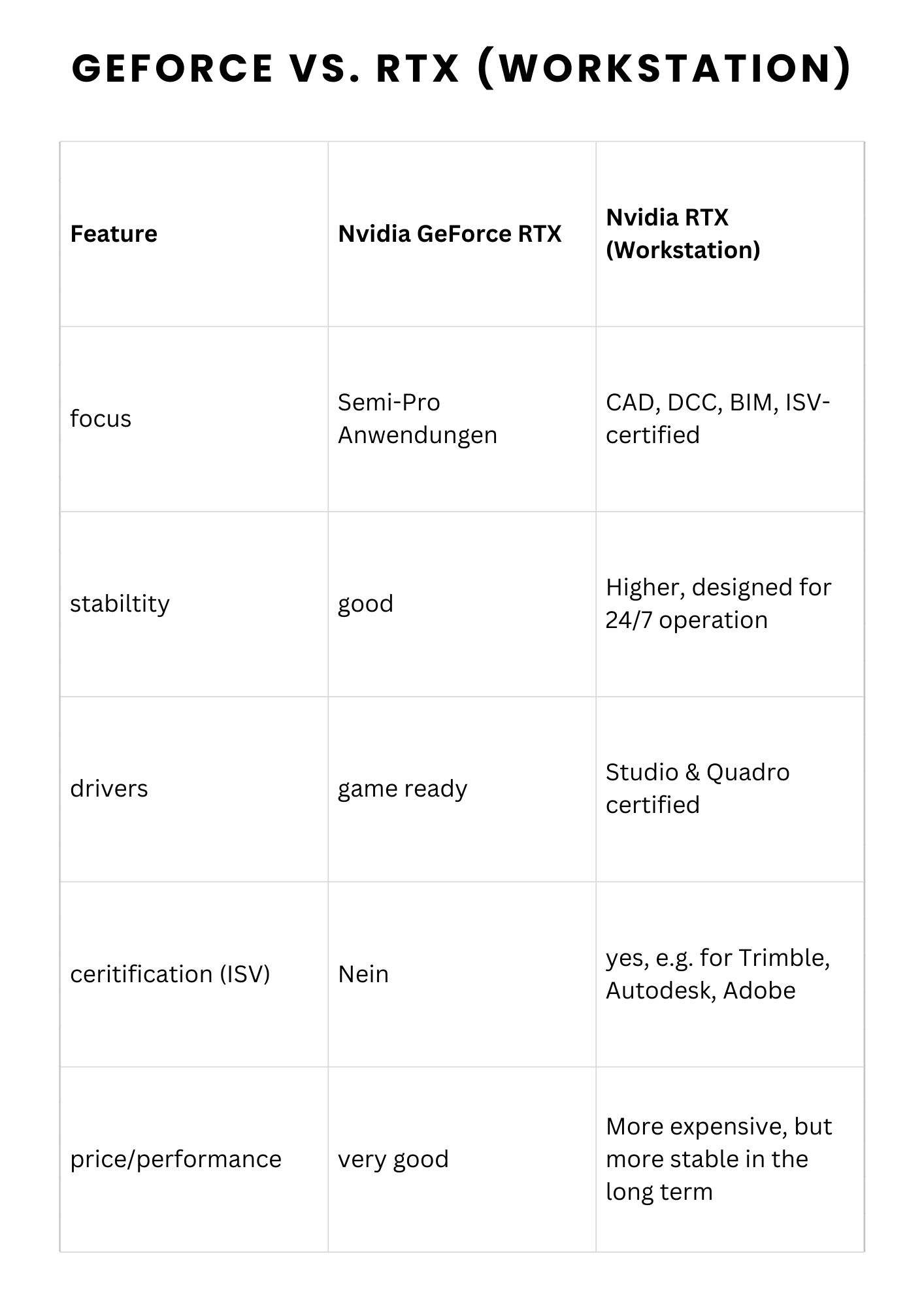
Certifications for business customers
For companies and architectural firms, we recommend ISV-certified graphics cards that are officially supported by software providers such as Trimble, Autodesk, Dassault Systèmes, and Adobe. These offer:
Greater compatibility
Long-term driver support
Fewer system crashes
Examples:
NVIDIA RTX A2000 / A4000 / A5000
NVIDIA RTX 4000 / 5000 Ada generation
Our conclusion:
For hobbyists or individuals with smaller projects, GeForce RTX cards are often sufficient. Businesses or professional users with higher requirements should opt for RTX workstation cards with ISV certification to ensure a long-term stable and compatible environment with SketchUp Pro 2026.
Optimal hard drive configuration for SketchUp Pro 2026
Recommendations for small, medium and complex projects in a professional IT environment
SketchUp Pro 2026 benefits greatly from a powerful storage architecture – especially for data-intensive modelling, extensive libraries and parallel use of other CAD/BIM software. The hard drive configuration has a direct impact on loading times, file access, stability and workflows.
Below are recommended configurations for different project sizes:
Small SketchUp projects – interior design, single-family homes, concept studies
System hard drive (C:):
Type: NVMe SSD (PCIe Gen3 or Gen4)
Capacity: 500 GB - 1 TB
Use: Operating system, SketchUp, V-Ray/Enscape, temporary files
Data hard drive (D:) (optional):
Type: SATA SSD
Capacity: 500 GB - 1 TB
Use: Project files, textures, component libraries
IT note: Separating system and project data improves performance and simplifies backups.
Medium-sized SketchUp projects – residential complexes, commercial properties, interdisciplinary planning
System hard drive (C:):
Type: NVMe SSD (PCIe Gen4, min. 3500 MB/s read)
Capacity: 1 TB
Use: OS, SketchUp, plug-ins, cache files
Data hard drive (D:):
Type: NVMe SSD or Enterprise SATA SSD
Capacity: 1 TB - 2 TB
Use: Project files, models, references
Archive/network storage (e.g. NAS/server drive):
Purpose: Long-term archiving, team access, version management
Connection: min. 1 Gbit/s LAN, ideal: 2.5/10 Gbit/s or Thunderbolt/USB-C (depending on workstation)
IT note: Use fast workstation SSDs with high TBW (Total Bytes Written) for sustained performance.
Complex SketchUp projects – urban development, BIM models, infrastructure planning
System hard drive (C:):
Type: High-end NVMe SSD (PCIe Gen4/Gen5, > 5000 MB/s read)
Capacity: 1 TB - 2 TB
Use: OS, software environment, virtualisation (e.g. VMs for testing)
Project hard drive (D:):
Type: Separate NVMe SSD (dedicated)
Capacity: 2 TB or more
Use: Large projects, XRefs, cache files, IFC data
Scratch/temp hard drive (E:) (optional):
Type: NVMe SSD
Use: Swap files, renderer cache, temporary files
Central storage (NAS/storage server):
Features: RAID 5/6, snapshots, automatic backups
Connection: 10 Gbit/s LAN, redundant availability, cloud sync if necessary
IT note: For team projects, PDM/BIM integration with central data management is recommended.
Our conclusion
A well-designed hard drive configuration is a key performance factor in SketchUp Pro 2026 – especially in combination with plug-ins, network access and complex workflows. For maximum efficiency and security, IT departments should always plan according to project size, relying on fast NVMe SSDs, clear data structures and scalable backup concepts.


